Tuesday, February 5, 2013
A Tour of My Yard

Saturday, May 7, 2011
Anecdotes from 119

From my first day in Tajikistan until about 5 weeks ago, I lived in an apartment building right next to the university where I work, 119 Rudaki. Due to plans to build a large new building on the site, all the residents were forced to move. Many others owned their apartments and are [hopefully] being given apartments in exchange for the ones they left. I was happy to find a place on up the street, but sad to leave the community I'd been a part of since day 1 here.
Here are some glimpses of the sights and sounds in the day of the life of 119 Rudaki.
7:30 AM--door to the neighbor's car shed outside my bedroom window creaks open as the neighbors get the car out to take 2nd grade Nodira to school
7:45--high heels on the wooden stairs as Nodira and her mother or grandmother come down
8:00 most Fridays--the same male voice calls out in Tajik: "Flour! Milk! Come on!" Announcing that people should come quick if they want to buy flour and milk without carrying it from the shop or market
8:45--I leave for the day and often exchange greetings in simple Russian with Lena, the middle aged woman who lives above me. She ends the exchange with "paka paka!" (bye bye) and blows me a kiss. I sometimes go up for tea with her and her elderly mother, aka "Tiyotya Faiya" (Aunt Faiya).
1:00 pm--home after university classes, preparing for the next day or afternoon classes, I hear the sound of Dilorom, the Tajik grandmother, sweeping and mopping the stairs and entryway.
3:00--if I happen to come home at this time, I sometimes see with amusement that Tiyotya Faiya has joined a young couple or a pair of friends trying to have a private conversation on the bench outside the door. It's her bench, and she just sits there and walks to whoever is there.
5:00--back from afternoon classes or meetings, I stop to say hello to the 5-6 girls playing in the yard. They beg me to join them for hopscotch, a jump rope type game, or drawing on the sidewalk with chalk. Chalk is sometimes provided by me. I can't get the hang of the jump rope game, but I try anyway. Tiyotya Faiya the grandmother keeps an eye on the children, yelling at them for walking in the grass. She also keeps an eye on any unfamiliar cars in the yard and asks if I can identify them.

7:00--all traffic on the main road stops except for a motorcade of police cars and black Mercedes sedans that streak down the street at lightening speed. The pre-recorded warnings blare out from the police cars, telling everyone to get out of the way. Police, stationed on every block, blow their whistles continuously. Someone very important is finishing another day at the office. Two minutes later, traffic flow is back to normal.
8:00--I cross the street to the little shop on the corner and buy milk, yogurt or other basic items. For an convenience store, this place also has a good stock of produce. The men who work there rarely crack a smile. But that doesn't mean they don't know about customer service. At Nav Ruz (Persian New Year in March) they helped me figure out where to go to see a buzkashi (dead goat polo game) match. Another time I left money there to be put on my cell phone account since the cell phone guy was out. A couple hours later I received an SMS that the money had been put on my account as requested.
9:00--the electric trolley bus lines pop and spark as the buses sail past the building to the next stop 2 blocks down. If you're outside, you can see the mini-fireworks display as the buses go along.
9:30--I hear the Tajik family coming downstairs to say goodbye to guests they may have had for the evening. Car doors shut and there are repeated exclamations of "well, come again!"
10:00--from my bathroom I can hear one of the older Russian neighbors snoring in the room that shares a wall with my bathroom; from upstairs comes the high-pitched voice of Tiyotya Faiya talking with her daughter.
11:00--I'm usually the last one in the building up, per my night-owl tendencies. I finally close the email, Facebook, Skype, etc and head to bed. The last thing I hear as I drift off to sleep is the heater or air conditioner switching on according to the thermostat setting...

Friday, January 21, 2011
In Memory of my Russian Grandfather

January 2011
I actually started a blog post about my Russian Grandfather last spring, but didn’t finish it. Yesterday I found out that he died on Wednesday of a heart problem. For someone I didn’t really know very well or for very long, it’s really made me sad. Grandfather was one of the group of people I claim as the best neighbors in Dushanbe. As a relative works outside, spray painting a metal Orthodox cross in preparation for memorial gathering tomorrow, I’ll post this tribute to Grandfather Colya, one of the many people who consistently brighten my day. One of the noor (bright, shiny) people, as they say in Tajik.
Photo: Umeda, me, Grandfather Colya, and Amina (the girls are in the Tajik family)
April 2010
My biological Grandfathers were both 100% Swedish by ethnicity, but I have a Russian grandfather here in Dushanbe. One of my neighbors is an elderly Russian man who I see outside at least once a day, smoking and walking around the yard and down the sidewalk with his cane. (The smoking and exercise is an ironic combination, I realize, but at least he’s exercising and not just smoking). One of my first interactions with Grandfather happened a few days after I first arrived in the fall of 2009. I didn’t know where to throw the garbage, and after a couple days, I decided it was time to find out. I looked up the word for garbage in my Russian dictionary, (it’s musor) and took my garbage bucket, prepared to knock on one of the neighbor’s doors and ask where I could dispose of the stuff. I took a deep breath—this trying to communicate without language is never easy. “Please God, help them understand me.” Paper with the word musor in hand and the bucket in the other, I opened my door. Just at that moment, Grandfather was coming out of his apartment across the hall with his musor bucket. I asked “gdye musor?” and Grandfather smiled and said something to the effect of “I’m going there now, come on.” He led me slowly to the dumpsters in the alley behind the building and we emptied our buckets. And that was the start of my friendship with Grandfather.
Since I decided to work on learning Tajik, my knowledge of Russian is about the same as when I arrived, which isn’t saying much, literally. I’ve added a few random Russian words to my vocabulary, because Tajiks use a lot of Russian borrowings. My collection of recently acquired Russian words includes nouns that describe modern objects, like “electric heater,” “microwave,” “stove,” etc. Nevertheless, Grandfather and I continue to communicate with our few common words. Here is a typical exchange between me and the Russian grandfather.
Me: “Zdrastrooytsay!” (hello in Russian)
Grandfather: “Zdrastrooytsay!”
[Big smiles on both sides. Grandfather doesn’t speak much Tajik, but he has adopted the Tajik custom of placing a hand over the heart and nodding slightly to show respect and greeting. I’ve adopted the custom as well, so we both do this. Sometimes, Grandfather reaches out and gives me a firm handshake. Occasionally he salutes me.]
Me: Kak vi? (How are you?--Russian)
Grandfather: “Normal,” or “hanging in there.” “And how are you?” he asks.
Me: “Harasho,” (Russian: good). “Sport?” I ask.
Grandfather: “Da, da, sport.”
Next Grandfather usually makes a circular motion with his cane to indicate that he is going to walk around the yard for exercise “sport”.
Me: “Harasho!” I give him the thumbs up sign.
Grandfather: “Kujo meraved?” (Tajik “where are you going?”)
Me: point to the university, store, or say “doma pradrooshka” if I’m going to a friend’s house.
Grandfather: “Harasho!” Another big smile.
Me: “Ladna,” (Russian, well, OK). “Dasvidanya,” (goodbye).
Grandfather: “Dasvidanya.”
[We both place our hands on our hearts Tajik style, more big smiles].
Well, Grandfather Colya, since our conversations were always bilingual, I’ll close with the Tajik to didan (til the next time we see each other). I don’t think you’ll be needing that cane anymore.
Sunday, December 19, 2010
The Thanksgiving Turkey

I thought it was time I wrote about the Thanksgiving turkey since it's almost Christmas. Another thing that I rather enjoy about Dushanbe is the challenge of finding certain foods. Sometimes this is frustrating, but I usually enjoy it because it's a chance to practice my language and interact with locals. The turkey was a case in point. It was a week before Thanksgiving and I was hosting a post-Thanksgiving gathering at my place. I wanted a turkey, but was prepared to buy several chickens as a substitute. Last year at this time several larger supermarkets had frozen turkeys (from Brazil, of all places) but this year they were no where to be found. So I asked around the international community and found out about a place outside a large market where they had live turkeys they would butcher for you upon purchase.
Based on the description of where this place was, I went to that area outside the market at about 5:00 PM the Tuesday of Thanksgiving. This is the place behind the large produce market where they sell mostly root vegetables in bulk. I think it's where people from smaller shops come to buy their vegetables. I asked a carrot and potato seller if he knew about turkeys, and he took me to a stall a couple sellers down where there was an empty pen. Since no one was there, he said we would go look for the seller, who apparently lived behind the row of stalls. So I followed the man down a narrow sort of walking alleyway, avoiding the gutter with water running to the street. We came out into a courtyard with simple dwellings around it. (Don't worry, there were still lots of people around). He asked at a couple of places until someone told him to come back the next day at 7 or 8 in the morning to find turkeys. He led me back out to the market area and told me that I should come find him before going to buy the turkey, because they would give him a better deal. "If they see you, they will make it expensive," he said. I thanked him for his help, but decided to negotiate the price on my own, since I think people are usually fair.
I didn't have time the next morning but I returned the morning of Thanksgiving to find the same pen with several turkeys in it. Bingo! I began talking to the man about the different sizes and prices of the birds. "That big one is 150 somoni," he said, which seemed like a good price. "Fine," I said, "I'll take it." Then the man said "are you married?" Oh no, I thought. Here we go again. What does me being married or not have to do with buying a turkey? I said that yes, I was married; it's my usual answer when men I don't know ask that question. It's much easier than responding to all the follow up questions and comments, which could include the suggestion that I marry a Tajik man. The turkey seller continued: "was it your husband that came yesterday and ordered the big turkey? A foreign man was here and ordered it and said he would come today." Darn. "No," I replied, "I didn't order a turkey. I'll take one of the smaller ones. I don't want to take one someone else ordered." So we agreed on a price of 80 somoni (just under $20) for one of the smaller birds.
The man went into the pen and the turkeys started gobbling. They knew something wasn't right. Wasn't it just the day before that Tom had disappeared after the man entered their pen? The man grabbed one of the birds under his arm and walked out of the pen. He sharpened his knife on the edge of the cement gutter and that was the end of the poor bird. While he plucked the feathers and poured boiling water over it to clean the down off, I went into the main part of the market to buy some other things.

When I returned, he put the turkey in a couple layers of plastic bag and I took it home. Since it was a couple days before my party I froze it, knowing that meat goes bad quickly because there are no preservatives. It was a bit tougher than a Butterball, but the flavor was good, and I made some tasty soup with the bones.
Here's the final product:

Thursday, December 9, 2010
Top 11 Things I Love About Dushanbe

11. You go to the market and the sellers tell you "we have spinach today" or "come back tomorrow for broccoli" because they remember you and what you buy.
10. After a car has been pulled over by a cop, the driver and cop first shake hands and ask about each others' health.
9. The fruits and vegetables have great flavor and they're generally either in season or you can't find them at all, meaning they haven't been preserved with weird chemicals.
8. You can go to someone's house without being invited. In fact, your host will grill you about why you haven't come in so long.
7. You can get in a taxi, start talking with the driver who speaks English, and find out he was in your colleague's English class last year.
6. If you live in the "center" you can be a 5-10 minute shared taxi ride plus no more than a 10 min talk from almost all your destinations.
5. You can eat lunch at a local "oshhona" for $1-2. That will buy you osh (national rice dish) or lagman (filling noodle soup), bread and tea.
4. Being called "Big Sister" as a term of respect, calling others "Big Sister," "Big Brother," or "Aunt."
3. You can meet the post office lady on the street outside the PO and she tells you that you don't have any mail. Then you have a 10 minute conversation. Reminds me of my hometown of 1,000ish people!
2. In the country's capital city, you can look up and see constellations on a clear night.
1. And...arguably the top thing I love about Dushanbe...being able to look up and see the snow-covered peaks of the mountains.
Monday, November 8, 2010
A Wedding Celebration
Last month I attended the wedding of one of my university students. This was the first wedding where I saw all the steps in a long day of celebrations. Previously I had only been to afternoon or evening parties at a restaurant. My student is ethnically Uzbek and is from a town about an hour and a half from Dushanbe. Follow along with each step in the wedding day!
Suray and I congratulate Dilbar as she waits for the groom to arrive.

The groom picks her up and they ride around town in a decorated car, stopping to take pictures at interesting places. Note that they don't smile: it's shameful to appear happy on your wedding day, especially for the the woman. Tradition says that if she's smiling too much it means that she's glad to leave her family or that she knows the groom on a level that she shouldn't.

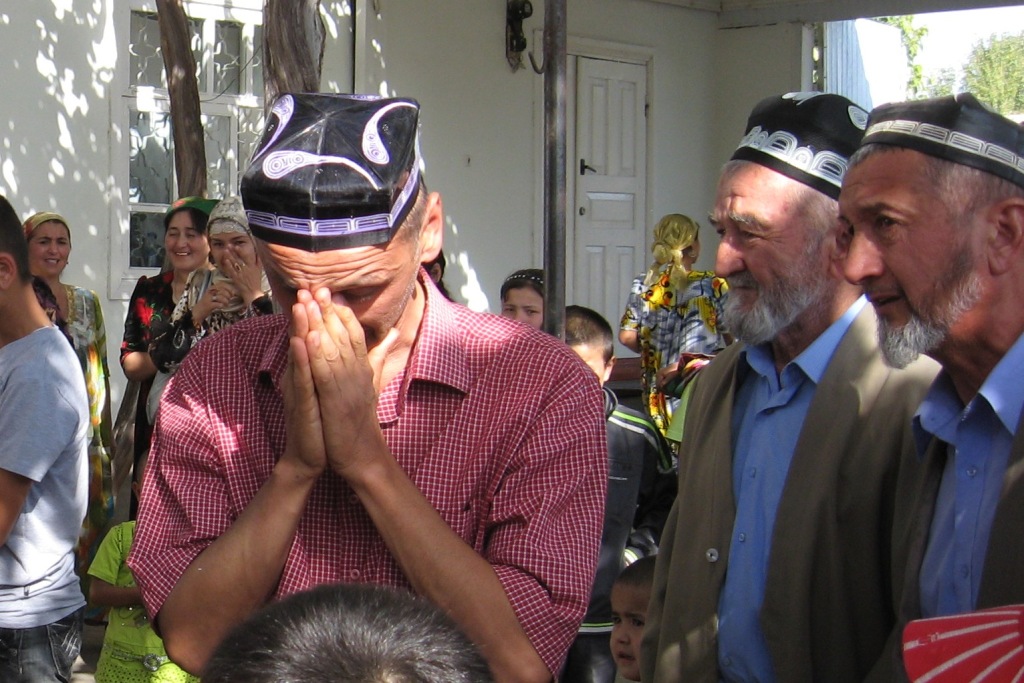
The bride and groom then go to the groom's house very briefly to greet his family. Then they return to her house, where she is able to rest for about an hour in a room with other women. She takes off the European dress and puts on a traditional dress. A robe is thrown over her and she is led out of the house to the sound of drums and lament-like songs. She weeps loudly as she enters the courtyard of the home where her father and grandfathers wait to say a prayer of blessing.

The bride throws herself at her father's feet, still weeping loudly. You can then hear a pin drop in the usually noisy courtyard as the men pray. The prayer is finished and nearly everyone in the crowd has to wipe tears from their eyes. The bride stands, is led to a car, and is taken back to the groom's house.

At the groom's house, there are 3 large rooms with tablecloths spread on the floor, and women packed around them. Two of the rooms have the bride's new wardrobe displayed on the walls. It's a stunning array of colors, sequins and bead work. Dresses of this kind cost at least $50 each, probably more.

Course after course of food is served. (Note: we also ate a meal and were fed a snack at the bride's house prior to this). By the last course, osh, the plates go basically untouched because the guests are so full. Before we leave, we are encouraged to take anything from the table we wish. This is apparently an Uzbek custom. Despite my protests, I end up taking candy, bread and fruit home.

During the meal the bride remains hidden behind a curtain. At the end of the meal, some of the groom's relatives come to greet her behind the curtain. Then she goes out to the courtyard and bows to a large crowd of women and children.

A couple of older women bring out a tablecloth filled with flour. They place it on the ground and the bride's hands are covered in flour, seemingly symbolic of the bread and food she will prepare for the household. All the while, women drum and sing.

After her hands are cleaned of flour, relatives come one by one and present the bride with gifts, placing them on a tablecloth on the ground. Then they each lift up the bride's veil in a tradition called "Rui Binon" (literally, "Seeing the Face"). They kiss her and welcome her to the family.

The bride backs into the house, bowing the whole way. Then she changes back into her Western style dress for the restaurant party.

The bride and groom enter the restaurant hall. Again, the bride bows constantly. Her friend, the maid of honor, stays at her side.

The bride's friends from the university dance to the live traditional music.

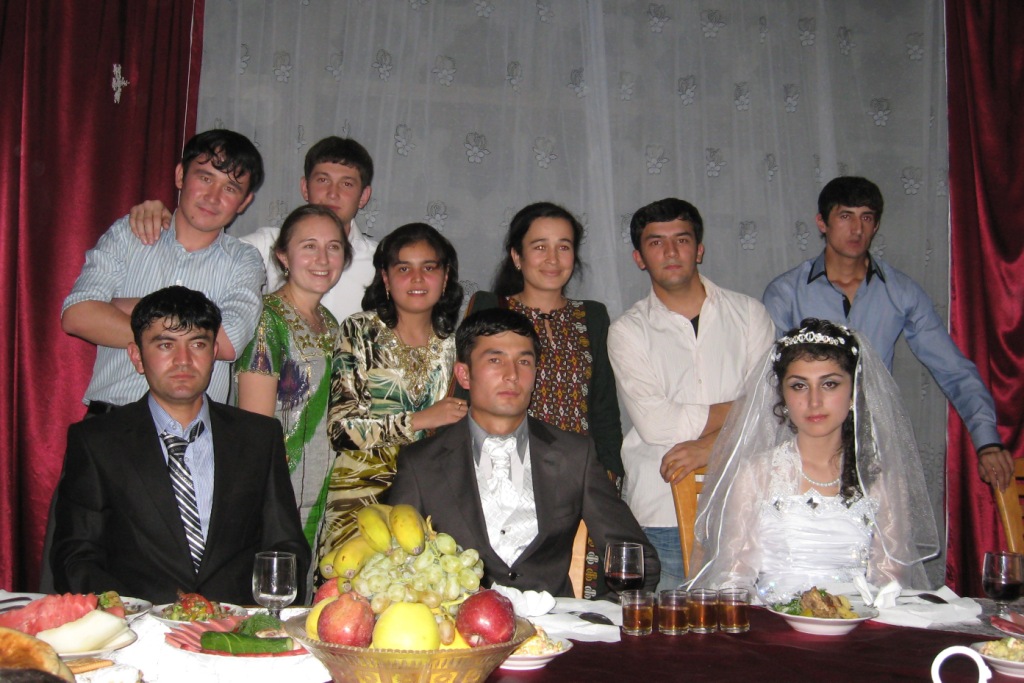
Guests take turns posing for photos with the couple. The guests can enjoy themselves, but the bride and groom don't smile, dance or eat during the party.

At the end of a long day, I return to my peaceful apartment. My thoughts tumble through the various paths life can take us, and how mine is so different from those of most girls here. I wish my student a "rohi safed" (white way/safe trip) on her journey of life.
Suray and I congratulate Dilbar as she waits for the groom to arrive.

The groom picks her up and they ride around town in a decorated car, stopping to take pictures at interesting places. Note that they don't smile: it's shameful to appear happy on your wedding day, especially for the the woman. Tradition says that if she's smiling too much it means that she's glad to leave her family or that she knows the groom on a level that she shouldn't.

The bride and groom then go to the groom's house very briefly to greet his family. Then they return to her house, where she is able to rest for about an hour in a room with other women. She takes off the European dress and puts on a traditional dress. A robe is thrown over her and she is led out of the house to the sound of drums and lament-like songs. She weeps loudly as she enters the courtyard of the home where her father and grandfathers wait to say a prayer of blessing.

The bride throws herself at her father's feet, still weeping loudly. You can then hear a pin drop in the usually noisy courtyard as the men pray. The prayer is finished and nearly everyone in the crowd has to wipe tears from their eyes. The bride stands, is led to a car, and is taken back to the groom's house.
At the groom's house, there are 3 large rooms with tablecloths spread on the floor, and women packed around them. Two of the rooms have the bride's new wardrobe displayed on the walls. It's a stunning array of colors, sequins and bead work. Dresses of this kind cost at least $50 each, probably more.

Course after course of food is served. (Note: we also ate a meal and were fed a snack at the bride's house prior to this). By the last course, osh, the plates go basically untouched because the guests are so full. Before we leave, we are encouraged to take anything from the table we wish. This is apparently an Uzbek custom. Despite my protests, I end up taking candy, bread and fruit home.

During the meal the bride remains hidden behind a curtain. At the end of the meal, some of the groom's relatives come to greet her behind the curtain. Then she goes out to the courtyard and bows to a large crowd of women and children.

A couple of older women bring out a tablecloth filled with flour. They place it on the ground and the bride's hands are covered in flour, seemingly symbolic of the bread and food she will prepare for the household. All the while, women drum and sing.

After her hands are cleaned of flour, relatives come one by one and present the bride with gifts, placing them on a tablecloth on the ground. Then they each lift up the bride's veil in a tradition called "Rui Binon" (literally, "Seeing the Face"). They kiss her and welcome her to the family.

The bride backs into the house, bowing the whole way. Then she changes back into her Western style dress for the restaurant party.

The bride and groom enter the restaurant hall. Again, the bride bows constantly. Her friend, the maid of honor, stays at her side.

The bride's friends from the university dance to the live traditional music.

Guests take turns posing for photos with the couple. The guests can enjoy themselves, but the bride and groom don't smile, dance or eat during the party.
At the end of a long day, I return to my peaceful apartment. My thoughts tumble through the various paths life can take us, and how mine is so different from those of most girls here. I wish my student a "rohi safed" (white way/safe trip) on her journey of life.
Saturday, September 11, 2010
Back to the Land of the Unexpected: A Journal Entry


This is my first post again in a long while. As you all know, I spent the summer in Minnesota with family and friends. There have been a lot of events in my first weeks back in Tajikistan, so I'm writing this in the form of a journal entry with some highlights.
August 17: departed Minneapolis for Amsterdam and then Istanbul. Thanks, brother Matthew, for taking me to the airport and dealing with my last minute "Argh! My bag is over 50 lbs! Hold this while I rearrange..."
August 18: enjoyed my last Burger King meal for a while at the Istanbul airport. Was looking at the schedule board to check my gate to Dushanbe and heard people discussing a gate change in Tajik. It was great to hear Tajik again, and to know I was in the right part of the airport! Saw other expats I knew in the waiting area, and had the very surreal experience of a young woman coming up to me and reminding me that her name was Mavluda and we had been seated next to each other on the same flight last year, when I first came to Dushanbe.
August 19 AM: Saw the lights of Samarkand and Buhkara, Uz, as we began the descent to Dushanbe. Landed, waited an inordinate amount of time for the luggage, and exited the airport. Was thankful both of my checked bags made it, since the airport staff had to find them in Istanbul and hand write tags to check them through to Dushanbe. Arrived at my cozy apartment at 5:00 AM, glad to be "home" again.
August 19 PM: Awoke from my long summer's nap an hour later than I thought, because my alarm was still on Istanbul time. Was up in time for a walk down the street, where I was greeted by one of the women who works at an office supply store I frequent. Yes, feels like coming home.
August 20-22: Spent the weekend at a dacha in Varzob with friends. A highlight was using the old, leg-powered giant swings at Varzob lake. Swings have always been my favorite, even if they are less than up to safety standards!
August 23: Traveled to a rural area of Tajikistan before reading the travel restrictions to that area due to the escape of 25 unfriendly characters from prison. Fortunately, everything on that front seemed calm during my stay. Heavy rains caused mud and rock slides in that area, which took out gardens and outbuildings. My friend's house was fine, and we didn't know about the mudslides til the next morning.
August 24-25: helped cook potatoes over the fire for the mud clean up crew, and went and surveyed damages. In the picture of the bridge, you can see how the underside of the bridge was plugged with boulders that had come down the hillside, forcing the water to make a new course on the left side. The power of all that water and those rocks was very sobering. Fortunately, no one was killed. Enjoyed an Iftor (end of the day of fasting) meal at a local family's house.
August 26: returned to Dushanbe, passing a number of new security posts. Had to stop to wash the car before entering the city, since dirty cars are one reason drivers can be stopped by police.
August 27-September 8: Had meetings at the language center where I'm working, helped orient new English teaching types, got new internet set up at home, and caught up with friends and neighbors.
September 9, Tajikistan's Independence Day: Enjoyed a wonderful day in Norak with some friends. Norak is an hour outside Dushanbe (see post from last Sept or Oct). We visited the dam, ate lunch on a platform over the river, and went swimming and boating. Watched evening fireworks from the 3rd floor of the house where some of the group are living.
September 10-11: Went from house to house, eating in celebration of Eid i Ramazon, the end of the month of fasting. On the 11th my students took me around to 4 of their houses. Explained that the guy in Florida is crazy and the event he planned did not actually happen. Enjoyed their hospitality, but don't want to see another piece of cake again for a long time :)
For more info on recent events in the country, go to www.reuters.com and search for "Tajikistan."
Monday, May 10, 2010
Victory Day


This month marks the 65th anniversary of the end of World War II in Europe. In the former Soviet Union, the day is celebrated on May 9th as Victory Day. Although sadly there are fewer and fewer members of the WWII generation with us, the collective memory lingers, particularly in countries where the war was fought on their own soil. I doubt there is a town of any size in the former USSR that does not have its own memorial. The city of Leningrad (now St. Petersburg) was under siege by the Nazi army for 900 days--nearly 3 years. Young men were recruited from all over the Soviet Union, including a large number of young men from Tajikistan, many of whom had never been beyond the mountains they could see from their home village. In a couple of museums here I've seen a display of pictures of elderly WWII veterans (see photo of the display in Khujand).
Yesterday one TV station showed an event in Kalingrad, Russia where thousands of young cadets stood at attention as a general in an open Jeep rode 20 meters, stopped, and proclaimed through a loudspeaker something to the effect of "We celebrate the 65th anniversary of the end of the Great Patriotic War." The cadets responded in chorus with a short chant, the Jeep drove another 20 meters, and the same thing was repeated. On another station, another parade was shown where hordes of white-haired men and women with dozens of medals on their chests walked through the streets.
My upstairs neighbor is a medalist, as they call them. "Babushka" (Russian for "grandmother) was a telegraph operator here in Dushanbe during the war, and has several medals to commemorate her service. A couple weeks ago I saw her older medals, and now she has a new 65 year medal that she has been wearing proudly. I tried to communicate to them that my Grandpa also worked in radio communications for the US Army, and that he was in Germany during the war. Babushka's husband, now deceased, went into the Red Army at age 17 and drove a tank in the war. Yesterday Babushka's daughter Lena showed me pictures of her father in his uniform and of the tank with branches strapped to it as camo. We all have stories, but I especially love spending time with older people who have seen so much history. I wish I could ask Babushka more questions, but she doesn't speak Tajik, the language I opted to take classes in.
After the picture of the Khujand heroes is: the Norak memorial, the Khujand memorial, me and Babushka, the commemorative signs around town in Tajik saying "no one and nothing will be forgotten," and the Dushanbe memorial with a Soviet tank.
Wednesday, March 31, 2010
Buzkashi
I had the amazing opportunity to see the famous Central Asia game of buzkashi on March 21st, the Nav Ruz "New Day" holiday. It's the New Year of the Persian world. I don't understand all the rules of this game, but the name means "goat grab" and the object is to grab a headless, dead goat that's been soaked in water and ride with it into a certain goal area. There are no fouls and no "out of bounds"; this game is hockey on a double dose of steroids, to put it mildly. This particular game was played in a field set in a low bowl and the spectators mostly stood on the slope around the field, but as you can see in the video, some of them chose to stand on the field. The riders can come in any direction at any time, so the crowd frequently runs from the action. The game came way too close for comfort to some of my expat friends; they were about a yard from a horse. I didn't get that close but had to run with the crowd several times. It's scary, but there's definitely a thrill. It was a very unique experience. The foreigners, especially women, were almost as entertaining to the spectators standing around us as the game itself. The crowd is 99.9% Tajik men wearing the standard black jackets and bowl haircuts, and a group of 15 foreigners, most of them women, stuck out even more than usual. People were basically quite polite, but people definitely got a kick out of how quickly we were prepared to run when the horses even looked like they were coming our way. The video speaks for itself--enjoy!
Monday, March 8, 2010
Women's Day


Photos: sign saying "Holiday congratulations, dear mothers and sisters"--(yes, I can read that now!); a couple walking--note the woman's large stuffed bear in plastic
Today, March 8th, is International Women’s Day. It’s a big deal in Tajikistan, something that became part of the culture during the Soviet days. In honor of Women’s Day, schools, universities and many businesses are closed. Technically, the name of celebration here was changed to “Mother’s Day” by the president, but most people still call it “Eidi Zanho” or “Women’s Holiday.” What follows is a collection of my musings about the holiday and the place of women in the society in general.
To commemorate the day, most people give gifts to mothers, grandmothers, sisters, wives, teachers, female coworkers, any women in their lives. Women give each other gifts as well. It’s like a combo of American Mother’s Day, Valentine’s Day, and a birthday. People are walking up and down the streets carrying flowers and stuffed animals, and vendors in the bazaars are selling gift basket type things wrapped in red and pink plastic. Sometimes men and boys even prepare meals for the women in the household, which is definitely not the norm here!
As someone who isn’t a mother, I really appreciate a day when all women are celebrated. For days, I’ve received congratulations from sellers in the bazaar, coworkers and students. On Friday, one of my students brought a homemade cake to class and the students gave me a gift! I was very touched, but unfortunately didn’t have my camera to capture the moment. The men in our section of the English department brought food to the office and had a party for the women, complete with cake and a speech by our supervisor. It was great!
For those of you wondering if there’s a men’s equivalent, there is Men’s Day (or Army Day) on February 23rd. At work the women planned a little celebration for the men in our office. People usually give gifts to the men in their lives, but it’s not nearly as big a celebration as Women’s Day. It wasn’t a day off, and I didn’t notice nearly the amount of gifts being carried down the streets. I don’t intend to sound anti-men, (see post “Surprised by Honesty” for examples of men’s kindness) but I have to admit I’m glad that Women’s Day is a bigger celebration, because every day in Tajikistan (except maybe Women’s Day) is Men’s Day.
At any point in their lives, the vast majority of men here have several women who cook, clean and do laundry for them. (And believe me, these tasks take a lot longer than they do in the States!) In most families, when sons marry, the wife comes to live with her husband’s family. That’s right, men live with their parents all their lives. In one household, there may be more than one married son, so a couple could have multiple kayleenho, or daughters-in-law. So a man almost always has a mother, grandmother, sisters, wife, and maybe aunts to do housework for him. Kayleenho often do the brunt of the work, and in many cases the mother in the household actually stops doing much housework when there is a new bride, and expects the new kayleen to do almost everything. One of my male students even wrote about this as a health problem in the country, because mothers-in-law often become obese when their daughters-in-law are there to do all the work! Women who have sons old enough to marry will sometimes tell their son “I need a kayleen, so we’re going to find a wife for you.” Then the son gets married whether he wants to or not, to someone selected by the family. Imagine being the poor wife who hopes her husband won’t beat or cheat, and that his family will be kind to her. An expat friend told me that a recent study reported that 50% of women are victims of some kind of abuse, and the real percentage is likely higher.
So, I’m not going to complain too much about not having a day for women in the US that includes me. I’ll take the opportunity to make choices about education, marriage, a profession, where I live, etc, over a holiday. But these choices did not always exist, even for women in the West. I’m so thankful for those like Susan B. Anthony who fought for women’s rights. Would that each day, not just the 8th of March, we lived in a world where the treatment of women increasingly reflects the truth that all people bear the Creator’s image.
Saturday, February 27, 2010
Alexandria


After spending 3 days in Cairo, my friend and I went up to Alexandria, Egypt for 2 days. Here are some pictures from there:
1. The view from the restaurant in our hotel, overlooking the Mediterranian
2. Kassie and I
3. Me with some Roman artifacts outside the catacombs in Alexandria
4. The inside of the new Alexandria library, opened in 2002 near the site of the ancient library, which was destroyed many centuries ago.
5. Me in the park near a presidential residence, overlooking the Sea
6. Entrance to the Catacombs visitor area. No photos were allowed inside, but we went down into the place where people were buried in Roman times.
7. The Qaitbay Citadel, built by a Sultan in 1477
8. The countryside view from the train ride between Cairo and Alexandria
Thursday, February 11, 2010
Pyramids and Sphinx


I had the amazing opportunity to travel to Egypt during the last part of January and beginning of February. The Fellows program opts to send Fellows in several neighboring regions to an annual English teacher's conference in Cairo, and adds on a couple days of ELF specific training. The requirement was that we submit a presentation proposal for the conference. They sure didn't have to twist my arm before I emailed in my proposal! I'll post some pictures of my presentation later.
I took a week of vacation before the conference and was able to travel with a friend from MN, Kassie, who met me in Cairo. It was great to see her and together experience things we've read about and seen in movies. We visited the pyramids at Giza--there are more than 100 pyramids in Egypt, but these are the most famous. We even went inside the Great Pyramid and also rode in a horse-drawn cart.
The pyramids are 4,500 years old! I can't conceptualize how old that really is. The Great Pyramid (or Khufu's pyramid) has 2.3 million blocks of stone that weigh an average of 2.5 tons each. That's a number I have an even harder time conceptualizing!
For me, the "Solar Boat" museum was almost as awe-inspiring as the pyramids. The 43 meter long boat was found buried near the Great Pyramid, dismantled. Restorers put the boat back together and now it's in a museum where visitors can view all sides of the boat as it's suspended in the middle of the museum. Historians are not sure if the boat was used by the pharaoh during his lifetime, to carry his body for the funeral, or if it was a religious item meant to carry him to the afterlife. Being from northern Minnesota, I've seen many boats in various states of disrepair, and they were much, much younger than this boat. Enjoy the photos!
Monday, January 4, 2010
Surprised by Honesty

Photo: an electric bus is pushed down the street by the money collector guy. They usually start up again pretty quickly.
This is something I've been meaning to write about for a while, and am finally getting around to. Although corruption runs rampant in most areas of education, government, and most other areas of life here, I'm often surprised at how honest business people are in their dealings with me. (Don't worry, I'm still very careful).
There are lots of examples, but here are a few recent ones:
Today I was at a computer store to get an ink cartridge refilled. I bought my printer at this place and they recognize me because I come in every few weeks for refills. I told the guy I wanted to buy a new cartridge also, and though he was out of them, he referred me to the shop two doors down where they had them.
Last week I was taking a shared taxi (it runs a set route and people get in and out like on a bus). The cost of a ride is 2 somoni, less an 50 cents. I happened to be the only one in the taxi at the time, and we stopped at a light, but the poor guy's car refused to get going again! Car and bus troubles aren't anything new, so I just chilled in the car for a minute. Then I realized we weren't going any farther, and I started getting out of the car. The man handed me my money back! I gave him half back, and hoped the best for his poor car.
A couple weeks ago I got into a mini bus going the wrong way. I double checked our destination with the other passengers, and they pointed me to the opposite side of the road. The driver immediately stopped so I could get out...and handed me my money back.
Wednesday, December 30, 2009
Wardrobe Experiences


I read C. S. Lewis' "The Chronicles of Narnia" books many times during my childhood and teen years. I watched the original BBC movies over and over and listened as my Dad read the books to me and my brothers. The other day it occurred to me that I feel like I'm having a "wardrobe" experience. If you're not familiar with the stories, the basic premise is that four siblings and other children go to the magical world of Narnia and have all kinds of adventures. They get to Narnia in different ways, but in the first book they travel to Narnia through a mysterious wardrobe in an old manor house. This particular wardrobe has no back panel; it leads into a forest in Narnia. In Narnia, the children witness the end of a perpetual winter; the sacrifice of the lion, Aslan; become kings and queens of the land; and grow to adulthood. Narnia years later, they stumble upon the wardrobe again, long after they have forgotten where they came from. When they go back through the wardrobe door, only 10 minutes have passed since they left Our World, and they are children again.
I've now been in Tajikistan for 4 months, but so much has happened in that time. I feel like I will have a similar experience as the Narnia children had when I return to the US this summer. I think it's helpful to look back at the end of the year, and I want to share some of my reflections about things I couldn't have imagined 4 months ago.
I've become more direct and to-the-point, at least in some situations. In the past couple of weeks, I've been dealing with students faced with failing my class. One guy, a 3rd year student, indicated that he would be in big trouble with his father. "You should have thought of that 5 semesters ago," I said. To another student, I pointed out: "My Tajik is better than your English," and "it's not my problem." Now, I'm not saying that these are great models of teacher-student interaction, but they are examples of how I've become firmer as a teacher.
Considering the amount of time I've been here, I've learned quite a bit of Tajik. I can have a very basic conversation with sellers at the market and now can understand if people are asking where I'm from or if I'm married! This evening at our English Faculty New Year's party, I was asked to give a toast/speech and to try to say it first in Tajik. [I think] I was able to express that I'm happy to be working with the teachers there and wish them health and happiness in the New Year. After that, my "Tajik was finished," to use the phrase of my co-worker, who sometimes says "My English is finished." I finished my New Year's wishes in English. Back to the Tajik, I can sit in staff meetings where the Dean talks on and on in Tajik and sometimes understand the basic idea.
There are also certain aspects of culture that you come to expect, to your own surprise. A while back I was talking to a married woman about her desire to improve her English by traveling. I asked her in surprise: "Would your husband allow you to go?" I now take it as a given that if a female student gets married, her husband may or may not allow her to continue to study. Now, even in the US, of course, family and spouses are always a consideration when making study decisions, but the fact that I asked about a person's husband allowing something surprised even me.
I've also flagged down busses on the main road (yes, you can do that here!), used the same spoon and cup as someone else, and starting stirring the tea by pouring a cup and dumping it back twice before pouring one to drink. Instant coffee doesn't even taste so bad anymore!
Those are some of the more light-hearted examples of how I'm changing and adapting, but there are deeper things too. I've come to appreciate so many things more, from the government and educational systems in the US to the amount of personal choice many people in the States have. Where at the beginning, I more frequently judged the way people do things, while I don't always agree, I'm at least understanding where people come from more. I understand some of the seemingly arbitrary laws and why teachers are very strict with their students.
I'd love to hear your reflections on this past year--send me an email or comment if you have something you'd like to share. This picture is a pretty typical street scene, and a picture of me hiking in the mountains Christmas Day. The views of the mountains with the snow have been incredible lately.
Soli Nav Mubarak! Happy New Year!
Thursday, December 24, 2009
Santa's Helpers


This week "Santa's helpers" the ELFs (English Language Fellows) of Tajikistan have been busy. A Fellow ELF organized a training for English teachers who work in a special program called English Access Microscholarship. Access provides just that, access to English language instruction for disadvantaged youth around the world who would not otherwise have the opportunity to participate in quality English-language classes. The program serves youth ages 14-16 in 55 countries and is not only English language classes but students also learn about American culture and democracy. Anyway, we did a two-day training, and many of the Access teachers from 9 partner programs in the country were able to attend! In the photo, me and my Fellow ELF, Sharon, are doing a session on holiday songs for the teachers. We donned my Santa and Elf hats and gave a couple of the teachers jingle bells to ring as we sang.
The training was really well received by the teachers and included ideas for teaching US geography, American holidays, group learning, and more. One of the participants wrote in their comments: "You really are Santa's friends--and [friends of] the Tajik people too." They were a great group of teachers to work with, but we were very tired by the end of the 2 days!
On Christmas Eve, I went to someone's house for a Thai-themed party. The food was delicious, and the host had this great nativity scene that was made in Tajikistan! That's me and Sharon in front of her Christmas tree in our Santa and Elf hats. Tonight (Christmas Day) I went to another couple's house for a lovely dinner, complete with Butterball turkey from the US!
Merry Christmas!
The opinions on this blog are not the opinions of the ELF program or the US Dept of State.
Subscribe to:
Posts (Atom)
